
The Global Nomad interviews Colin Molyneux about Off Road Wheelchairs in Kenya:
GN: The are many wonderful charity projects around the world. What are the distinctives of "Off the Road Wheelchairs"?
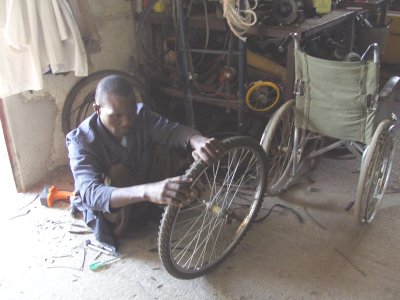
Colin: These Off Road Wheel Chairs have been developed over the past 4 years, in answer to an identified need in our AIM * /AIC Child Care Centres in Kenya. For years, our staff members in the Homes have used conventional wheel chairs, to help the disabled children to get around. However, these have proved to be of limited value in the rural areas, where they must operate in soft, thorny or rough terrain. So I was asked to try to come up with something better - and yet simple enough to be produced in basic work-shops. Therefore, these machines are designed to be able to cope much better with the rural conditions. They have larger (puncture-proof) wheels / tyres, which aid off-road ability.
GN: In what part of the world does "Off the Road Wheelchairs work"?
Colin: So far this Project has been limited to the AIM International's * work in Kenya, largely since I am an AIM staff member.
GN: How did "Off the Road Wheelchairs" come into being?
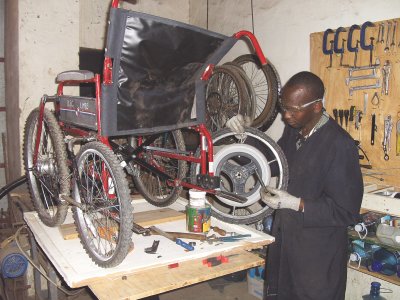
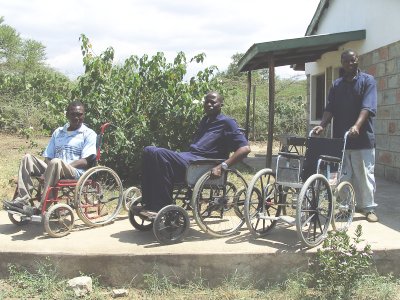
Colin: The first Off Road Wheel Chair I made was for a paraplegic pastor in Northern Kenya, when I worked in that area. That original model was a 3-wheeler. Now, within this current project, the wheel chairs are all 4- or 6- wheeler models, since these are more stable on uneven ground and can more easily be folded, for transportation purposes.
GN: Give some examples of feedback and response to your project so far?
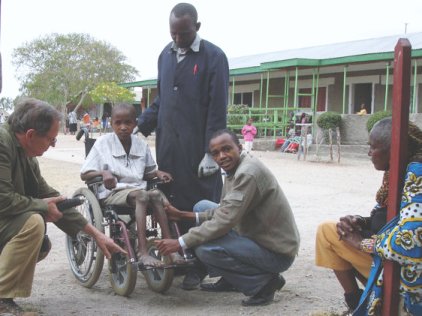
Colin: The most substantial feedback as to the appropriateness of these machines, has probably come from the staff members and the children themselves. It has been very gratifying to see how eager the disabled children are to try out the various models for themselves; their faces 'tell a lot', and also, they are normally reluctant to let someone else have a try!
GN: Are there current plans for expansion?
Colin: It is about time for me to start looking at other areas of need, within and outside of Kenya. During the first half of 2010, I hope the two Child Care Centres in Kenya will be able to build enough machines, to enable them to sell several examples to people elsewhere who need them. This in turn will create a small fund to assist in further purchases of parts etc. I also am now considering one or 2 possibilities of future work and need.
GN: What is the biggest challenge for "Off the Road Wheelchairs" ?
Colin: Current plans, include the challenge of designing these three basic models, so that they can be built from programmed instruction sheets, in very basic workshops in rural Africa, with materials which can be purchased in any (or most) large towns. The alternative to this is that of shipping quantities of conventional wheel chairs and used mountain bikes of various sizes, out to a suitable location, where a brief instruction time can introduce the workshop people to the necessary skills of building the "Born Again" Wheel chairs out of these basic ingredients. (All of the models are based on ordinary wheel chairs with certain standard mountain- bike parts taking the place of some of the conventional pieces).
GN: How can folk get involved right now?
Colin: There is certainly a need for funding, to enable the ongoing development of the Off Road Wheel Chair Project.Any gifts or cheques can be sent to: Rev. Colin J. Molyneux and clearly marked / made payable to; Wheel Chair Project.
* AIM International is an Interdenominational Mission Society working in many countries of the Africa region.
UK HQ is: AIM International, Halifax Place, Nottingham NG1 1QN
These 3 models or systems are designed to suit different types of disability. The 4-wheel pushed machine, for people too weak or disabled, to propel themselves. The 6-wheeler, can be self- or helper-propelled. The Chain-drive example is intended to be mostly self-propelled.